Archive for the ‘Literary translation’ Category
Nadja in French, and Nadja in English
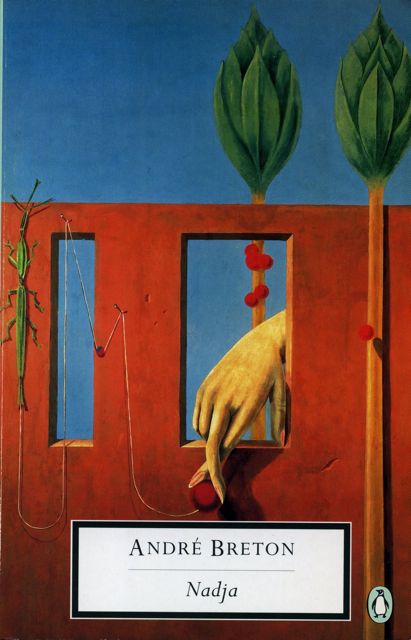
It is a well-known fact of course that something gets lost when you read a work in translation, but sometimes the loss can be greater than expected. Take André Breton’s Nadja, for instance. To the best of my knowledge, the only English translation available is the one by Richard Howard. It was initially published in 1960 and is still published today by, I think, at least two publishers: Penguin and Atlantic Books. The Penguin edition (pictured below right) dates from 1999 and includes an introduction by Mark Polizzotti. Howard’s translation, however, is of the first edition of Nadja, which was published in 1928, long before Breton brought out his second, revised edition in 1964. Strangely enough, this fact is not mentioned on the front or back covers of the Penguin edition, although Polizzotti does mention it in his introduction, albeit in a footnote. I haven’t ever read the two works closely, but the second edition notably includes an “avant-dire”, a preface of sorts, in which Breton evokes his use of photographic illustrations in the book, of which there are indeed more in the later edition.

The Craft of Translation
Edited by John Biguenet and Rainer Schulte, The Craft of Translation is a collection of essays on literary translation that covers a wide range of texts (theatre, fiction, poetry, epic) over a long period of time (from the eleventh to the twentieth centuries) and a no less vast range of countries (from South America to Japan).
The essays were all written by literary translators who have tackled major writers past and present, and although not all their names may be familiar, some at least are worth mentioning alongside some of the authors they have worked on: Gregory Rabassa – Julio Cortázar, Mario Vargos Llosa, Juan Goytisolo; Margaret Sayers Peden – Isabel Allende, Octavio Paz, Carlos Fuentes; Donald Frame – Voltaire and Molière; William Weaver – Italo Calvino, Alberto Moravia, Primo Levi; Christopher Middleton – Goethe, Nietzsche, Robert Walser, Paul Celan; Edward Seidensticker – Lady Murasaki’s The Tale of Genji.
The volume is interesting because it gives a quite detailed and well-illustrated overview of the translation process in practice. And indeed, despite the differences in genre and source language, the volume is quite coherent, since all these translators face a number of similar problems, such as how to convey the sounds of a particular language, or how to translate curses and oaths, or how to render local expression and idiom in English. The risks involved in collaborative translations are also evoked by one essayist, who notes that his Americanisms did not mix well with the Britishisms of his fellow translator. The question is also raised by a translator of poetry as to whether his voice should show or, on the contrary, be mute. This issue ties in with the question as to the extent to which the translator should retain a sense of differentness in his translation. Last but not least, the very issue of translatability is raised repeatedly: while one essayist calculates the relative feasibility of a translation before starting on a job, another suggests that the translation of a poem should always be followed by a blank page for the ideal translation, which, of course, always remains out of reach.
Published in 1989 by the University of Chicago Press in their series “Guides to Writing, Editing and Publishing”, this volume is labelled “Reference / Literary Criticism”, and quite rightly so. Indeed, it emerges clearly from these essays that these translators are engaged in literary interpretation that is far from superficial, and their readings of the original works can teach us much.

Five variations on Don Quixote’s opening line
No two translations are ever the same. Even if you were to ask one and the same translator to work on the same text twice, he or she would most likely make different choices the second time, resulting in a more or less different text.
In much the same vein, different translators working on the same text will produce different translations, no matter how straightforward that text might seem to be. This will be all the more so when the different translators are from different eras.
As an example, here are five translations of the opening line of the “Author’s preface” to Cervantes’s unsurpassable Don Quixote, published in two parts in 1605 and 1615. These translations are from the early seventeenth, the mid eighteenth, the late nineteenth, the late twentieth, and the early twenty-first centuries. I’ve highlighted the various parts of the sentence to make the comparison stand out more, and to show how virtually every part of the sentence is subject to change.
Thomas Shelton’s translation of the first part of Don Quixote was, according to Wikipedia, the first to be published in any language. It appeared in 1612, and it is available on Bartleby:
“Thou mayst believe me, gentle reader, without swearing, that I could willingly desire this book (as a child of my understanding) to be the most beautiful, gallant, and discreet that might possibly be imagined”.
Although Charles Jarvis’s translation was first published in 1742, it is still available in the Oxford World’s Classics series (pictured below left):
“You may believe me without an oath, gentle reader, that I wish this book, as the child of my brain, were the most beautiful, the most sprightly, and the most ingenious, that can be imagined”.
The translation by John Ormsby (1829-1895) was published in 1885, and is currently available on Project Gutenberg:
“Idle reader: thou mayest believe me without any oath that I would this book, as it is the child of my brain, were the fairest, gayest, and cleverest that could be imagined”.
John Rutherford’s version was published by Penguin in 2000, and revised in 2001 and 2003 (pictured below centre):
“Idle reader: I don’t have to swear any oaths to persuade you that I should like this book, since it is the son of my brain, to be the most beautiful, elegant and intelligent book imaginable”.
Secker and Warburg released Edith Grossman’s translation in 2003 (pictured below right):
“Idle reader: Without my swearing to it, you can believe that I would like this book, the child of my understanding, to be the most beautiful, the most brilliant, and the most discreet that anyone could imagine”.
If anything, these variations on the original make me wonder, not so much about what Cervantes meant, but how he would have formulated it had he written in English. But just as that is an impossibility, neither can there be such a thing as an “ideal” English translation (or in any other language, for that matter). And so I’d like to finish off with the original opening line from the Primera parte del ingenioso hidalgo don Quijote de la Mancha (from the online edition available at the Centro Virtual Cervantes):
“Desocupado lector: sin juramento me podrás creerque quisiera que este libro, como hijo del entendimiento, fuera el más hermoso, el más gallardo y más discreto que pudiera imaginarse“.


 PaTRiCK LeNNoN TRaNSLaTioN