What are my duties? A story to be confirmed
Five six-month residencies succeeded one another between 2008 and 2011 in a house in 1030 Brussels, part of a project commissioned by the non-profit arts lab nadine and entitled TBC: To Be Confirmed. Conceived and compiled by Rebecca Lenaerts, the small booklet What are my duties? A story to be confirmed collects interviews with the five artists and collectives that participated in the project. The booklet is published in Dutch, English and French. I took care of the English and French translations from the Dutch.

Oscar le Sauvage
A review in this week’s TLS reminds me of something I had perhaps forgotten, unless it’s something I never knew, and that is that Oscar Wilde’s tragedy-in-one-act Salome was first written en français. It was then translated into English by Wilde’s lover, Alfred Douglas, but the latter’s translation was apparently so incompetent that Wilde had to rework it himself. This, it seems, is why Douglas’s name was removed from the title page of the English text and only mentioned in Wilde’s dedication for the play. It’s uncertain then whether the English text really should in fact be considered a translation. In any case, if you want a new English translation, then you can read Joseph Donohue’s text, published by the University of Virginia Press. The review of Donohue’s translation in this week’s TLS is by Joseph Bristow. This reproduction of one of Aubrey Beardsley’s drawings is from the review in this week’s TLS.

Teju Cole’s “Open stad”
Who ever said British and American reviewers were the only ones to omit the names of translators in their reviews of foreign works? This recent review by Michaël Bellon in the Dutch-language Brussels weekly Brussel Deze Week of Open stad, the Dutch translation of the young American writer Teju Cole’s novel Open City, makes no mention of the translator’s name. But perhaps the reviewer was simply distracted by the fact that the novel, about a young Nigerian-German psychiatrist in New York a few years after 9/11, is in part set in Brussels, where the protagonist arrives shortly after the murder of a young man for his iPod. Novels partly set in Brussels are indeed relatively rare in fiction, let alone contemporary American fiction. Be that as it may, I found the translator’s name on the publisher’s website: it’s Paul Van Der Lecq.

Awaiting translation: David Bronsen’s Joseph Roth
My previous post centred on Melvin Jules Bukiet’s novel After, which was published in the US in 1996 but which, to the best of my knowledge, has not been translated into French or Dutch. I chose it as an example of English-language works that fail to get translated into foreign languages, although they deserve to be.
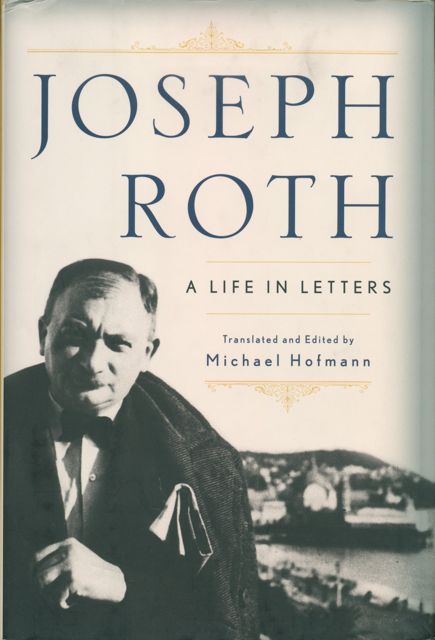
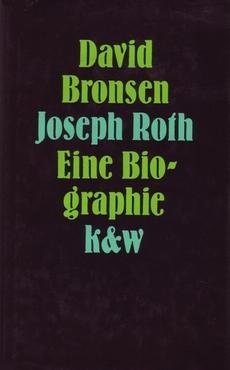
This post centres on a counter-example, as it were, i.e., a foreign-language work that has not been translated into English although they deserve to be. There are allegedly a lot more of these, but perhaps this example is a bit out of the ordinary since it is neither a novel nor very recent. It’s the biography of Joseph Roth by David Bronsen, which I was reminded of when reading Michael Hofmann’s recently published translation of Joseph Roth’s correspondence, Joseph Roth: A Life in Letters (the edition shown here is the Norton edition; the UK edition is published by Faber). Bronsen’s biography of Roth was initially published in German in 1974 by Kiepenheuer & Witsch (cover pictured below), and in a shortened version in German in 1993. It is supposed to be a brilliant biography, but despite the renewed interest that Roth’s work received in the English-speaking world in the 1990s and 2000s (in large part thanks to Hofmann’s new translations), no English version is available. Strangely enough, however, an English translation from Chatto & Windus does seem to have been in preparation in 1999, but nothing seems to have come of it, although a ghostly reference does come up in the search results on Amazon or on BookDepository, for instance.
Lastly, it’s perhaps worth mentioning that a new biography of Roth was published by Kiepenheuer & Witsch in 2009: Wilhelm von Sternburg’s Joseph Roth: Eine Biographie.
Awaiting translation: Melvin Jules Bukiet’s After
While it’s true that very little foreign-language literature (i.e., not English) gets translated into English, and while it’s also true that foreign-language book markets are dominated by a disproportionate percentage of English-language titles, it’s no less true that some English-language books deserve to reach an audience outside their native homeland, but for some reason or other fail to do so. One such book, I believe, is Melvin Jules Bukiet’s wickedly funny novel After, published in the US by St. Martin’s Press in 1996.
A black comedy set in the immediate aftermath of the Second World War – after the liberation of the concentration camps –, it follows three former inmates as they start wheeling and dealing on the post-war German black market, before their leader becomes set on stealing a four-foot cube of gold from a military camp (you can guess where the gold came from) and making their way to Far Rockaway. It’s a darkly comic picaresque tale which, despite its setting and subject matter, thrives with life and real humanity, and that’s what’s great about it: it’s because these characters are not saints or martyrs that they are actually human, and that in turn is what gives them life as characters. Needless to say, Bukiet, who is himself the son of Holocaust survivors, adopts neither the pious nor the reverent approach to be found in most Holocaust literature. And though one need certainly not exclude the other, Bukiet’s approach is certainly refreshing, and probably more honest than many more conventional novels.
To the best of my knowledge, although a German translation by one Benjamin Schwarz has been published by Luchterhand Literaturverlag as Danach, the novel has been translated neither into French nor into Dutch, although why this is is a mystery to me given how good this book is.

Belgian Architecture Beyond Belgium
The Belgian architecture review A+ is bringing out a special issue in English at the end of the month devoted entirely to ‘Belgian Architecture Beyond Belgium’.
This special issue provides the first overview of the export of Belgian architecture. It opens with a historical synthesis of Belgian architecture on the international stage in the 19th and 20th centuries. This is followed by three round-table discussions on the subject of Belgian architecture outside Belgium featuring key players in the field, whether architects, town planners, engineers or academics. Twenty-five international projects by Belgian architectural firms are then given concise presentations illustrated with photographs and plans.
My fellow translator Gregory Ball provided the English translation of the introduction, and I translated all other materials from Dutch and French into English. I was also responsible for proofreading the entire issue.

Daan van Golden: Apperception at WIELS
Apperception, an exhibition of works by the Dutch artist Daan van Golden, opened today at WIELS, the contemporary art centre in Brussels. The exhibition provides an overview of van Golden’s work from the 1960s until today. It mostly consists of paintings, although it does also include a series of van Golden’s photographs of his daughter Diana. Apperception runs until 29 April 2012.
The painting pictured below on the cover of the visitor’s guide is entitled White Painting and dates from 1966. I was responsible for the English translation of the visitor’s guide.

Translating English into English
No one ever said translation had to take place between two different languages, so why not between two different versions of the same language? Below (centre and right) are two examples of translations into contemporary English from Old English and Middle English, respectively: Seamus Heaney’s Beowulf (Faber & Faber, 1999) and Simon Armitage’s Sir Gawain and the Green Knight (Faber & Faber, 2007).
I was reminded of these two volumes recently when I came across a copy of Heaney’s translation from the Middle Scots of Robert Henryson’s The Testament of Cresseid & Seven Fables (Faber & Faber, 2009). In his introduction to this bilingual edition, Heaney mentions the three motives for translation identified by Eliot Weinberger: advocacy for the work in question, refreshment from a different speech and culture, and the pleasures of ‘writing by proxy’. Food for thought at the start of the new year.


Roddy Doyle’s translation of Gogol’s The Government Inspector
Roddy Doyle’s translation of Gogol’s political satire The Government Inspector opened in late November at the Abbey Theatre in Dublin. On this occasion, Doyle published an interesting piece in the weekend supplement of The Irish Times, providing some insight into the translation or adaptation process involved when the re-writer doesn’t know the original language. Since he doesn’t speak a word of Russian, Doyle had to rely on a raw translation of the play from which he then created his own version. Funnily enough, Doyle opens his essay with five different translations of the opening line of the play, a reminder, if necessary, that no two translations are ever identical. The play runs until 28 January 2012.

Edith Grossman on translation
Yale University Press launched its “Why X Matters” series in 2010, each volume designed to present “a concise argument for the continuing relevance of an important person or idea”. So far the series contains volumes on the US Constitution, architecture, poetry, the Dreyfus affair, the philosopher Hannah Arendt, and the religious thinker Reinhold Niebuhr. It also contains a volume on translation published in 2010 and written by the American literary translator Edith Grossman, who has translated such writers as Gabriel Garcia Marquez, Mario Vargas Llosa and Carlos Fuentes. Strangely, this concise book left me with the impression that Grossman was not so much answering the question as to why translation matters, but also and perhaps especially the question as to why translation matters to her. This is not a bad thing, however. On the contrary. It’s precisely because it does matter to her that she makes a convincing case for translation in general.
After a brief introduction in which she explains how she got into literary translation, the first chapter sketches a picture of the relations between writers, translators and readers and establishes the central importance of translation. The second chapter concentrates on her approach to translating Cervantes’s Don Quixote: how she dealt (or not, as the case may be) with the centuries of scholarship behind the novel, or with the temporal distance separating her from Cervantes’s world, or the number of English translations that have been produced over the centuries (I was surprised to see that there were only 20 or thereabouts). The third and final chapter focuses on her translations of poetry and the particular difficulties involved in this exercise.
The book ends somewhat surprisingly with a “personal list of important translations” which covers authors from ancient Greece to today: from Sophocles and Homer to Dante and Cervantes, from Nietzsche to Dostoevsky, and from Rilke to the ubiquitous W.G. Sebald. It’s a surprising addition to the book, since it reads a bit like a list of canonical works with a lot of gaps in it. It’s surprising also because it somehow seems strange to have so many classic works of literature categorized as “translations” (instead of as “classics”, say). But then that is precisely the point of this book: to make us realize how essential translation is, how central it is in our world, even when we take it for granted and fail to see it for what it’s worth.

 PaTRiCK LeNNoN TRaNSLaTioN